How a humble bean became the standard for clean-burning, fragrance-true premium candles - and what to look for when sourcing it for your atelier.
Soy wax did not arrive in artisanal candle making as a marketing trend - it arrived as a quiet correction. Paraffin, the petroleum byproduct that dominated the twentieth century, burns hot, releases visible soot, and carries fragrance unevenly. Soy, distilled from a renewable bean, offered something rare: a wax that performed at a lower melt point, threw scent with patience instead of force, and biodegraded gracefully.
What you are actually buying
Not all soy is equal. Look for a single-origin, GMO-free wax flake with a melt point between 49 and 54 degrees Celsius. Below that range your candle will sweat in summer; above it, the cold throw - the scent the candle gives off before lighting - flattens. Reputable suppliers will publish their saponification value and acid value on the technical data sheet. If they will not, walk away.
The pour temperature ritual
Pour too hot and you get sinkholes around the wick. Pour too cold and you get a frosted, uneven top. The window is narrower than most tutorials admit: 60 to 65 degrees Celsius for a standard 8 percent fragrance load. We teach our students to pour by feel, watching the wax catch the light as it cools, the moment the surface tension begins to firm.
Why we still hand-stir
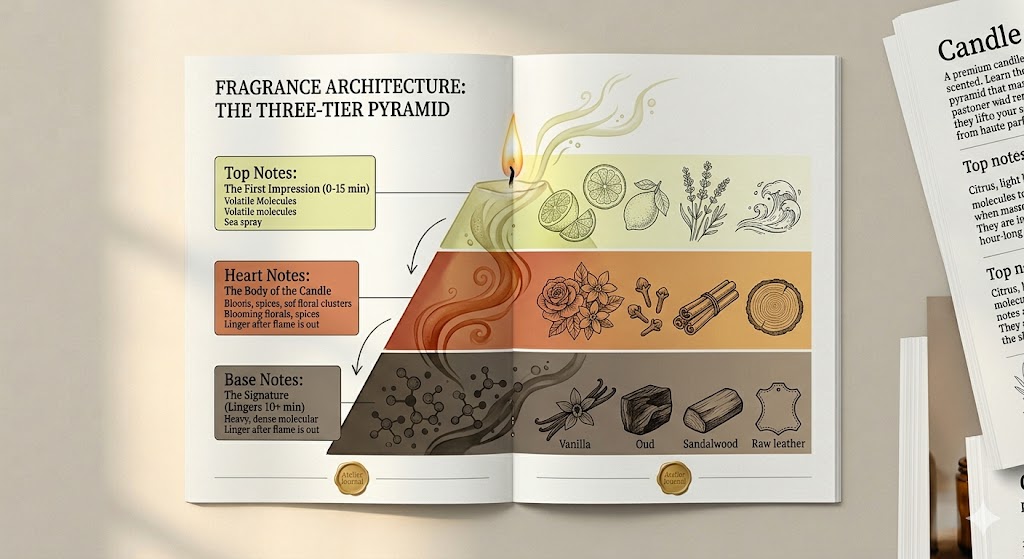
Industrial candle production homogenises fragrance with high-shear mixers. The result is a uniform but slightly muted scent. Hand-stirring, in slow figure-eights for ninety seconds, preserves the volatile top notes that make a candle feel alive in the first ten minutes of its burn.
Soy is not a shortcut to a better candle. It is a more honest starting point.